



An Exclusive Interview with Tim Chiang, Vice President of Chief Telecom: How Chief is Building an East Asia’s Compute Transit Hub?
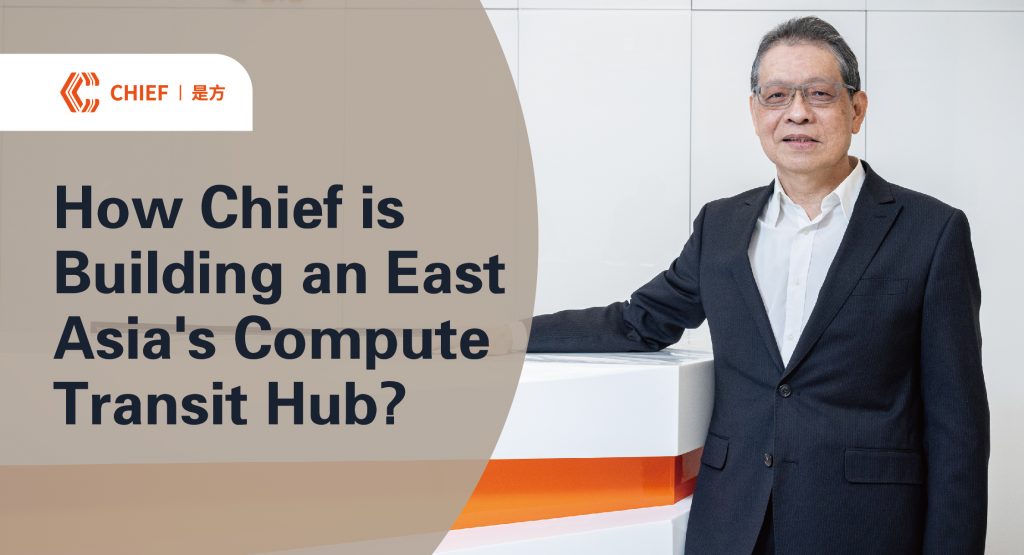
Tim Chiang, Vice President of Chief Telecom
In the era of AI, the key to success lies not only in the sheer strength of computing power but also in the seamless flow of compute and data. With “carrier-neutrality” at its core, Chief Telecom has built a platform for the free exchange of cloud, network, and compute resources. Combining its AI-optimized internet data centers (IDCs) with Taiwan’s unique geographic advantages, Chief Telecom aims to become the premier AI compute transit hub in East Asia.
The dawn of the AI era has once again thrust Taiwan into the global spotlight, with AI effectively becoming Taiwan’s new calling card.
While global competition predominantly focuses on GPU specifications, model parameters, and the scale of computing power—with investments in NVIDIA’s latest chip architectures and next-generation AI supercomputers by cloud providers easily reaching tens of billions of dollars—those on the front lines of the industry know what truly dictates the large-scale commercialization of AI. It is not just how powerful the compute is, but whether data and compute can flow without friction.
As model sizes expand exponentially and real-time inference along with multi-region deployment become the norm, AI operations have evolved beyond single-point computing into distributed systems heavily reliant on the network. Data must travel at ultra-high speeds between disparate nodes, and computing power must be orchestrated in real time. This shift has progressively transformed the role of the data center from mere colocation space into a critical hub that interconnects compute, network, and cloud services.
Tim Chiang, Vice President of Planning at Chief Telecom, captured the essence of this evolution in a single sentence: “AI is not just about computing; it is essentially a network logistics system. Even if you have the most advanced factory, your goods won’t ship out if there are no highways connecting it to the world.” In his view, the crux of future AI competition will not merely be about who owns the most compute, but who can engineer an environment where computing power can circulate efficiently.
The Value of Carrier-Neutrality
When discussing Chief Telecom’s positioning within Taiwan’s AI landscape, Tim Chiang highlights “Carrier-neutrality” more than anything else—even before the scale of data center. This technical term is a structural prerequisite that dictates whether global cloud and AI cloud providers choose to establish their presence here.
Reflecting on the consolidation history of Taiwan’s telecommunications industry around 2006 and 2007, Chiang noted that while the top three Type I carriers acquired the three largest Type II carriers respectively, Chief Telecom remained the sole exception. Following its acquisition by the Chunghwa Telecom Group, Chief Telecom continued to operate with absolute independence.
Recalling a statement by Chunghwa Telecom’s chairman at the time—”The heart desires what the hands cannot enforce”—Chiang explained that while the market hoped Taiwan could attract more international network and cloud providers, the harsh reality was that global clients simply would not enter if the data center lacked neutrality.
“International clients see Taiwan, but they are not necessarily willing to enter. The pivot point is carrier-neutrality,” Chiang stated bluntly. For multinational services, a data center bound to a single telecom conglomerate imposes barriers to market entry from day one. This explains why, for the past two decades, Chief Telecom has steadfastly maintained its carrier-neutral positioning, refusing to become a mere extension of any single carrier.
To make this clearer for a non-technical audience, Chiang likened the model to the platform economy: “If you go to McDonald’s and ask for KFC’s fried chicken, they won’t sell it to you. Go to KFC and ask for McDonald’s fries, they won’t give them to you either. But if you use a platform like Uber Eats or Foodpanda, you can order from MOS Burger, KFC, or McDonald’s all at once, and the platform delivers them all. The role Chief Telecom plays is exactly that of such a platform.”
This neutral architecture allows diverse carriers, compute providers, and cloud services to achieve high-density interconnection within the same facility.
Chiang emphasized: “Regardless of whether a user is with Chunghwa Telecom, FarEasTone, or Taiwan Mobile, once they enter Chief Telecom’s ecosystem, they can connect via the shortest and most optimized routing.” Over time, Chief Telecom has progressively evolved into Taiwan’s largest telecommunications hub, cementing itself as an indispensable gateway that global players cannot bypass when deploying infrastructure in Taiwan.
LY2 IDC: Built for AI Workloads
The emergence of AI servers has completely inverted the design logic of data centers.
Tim Chiang pointed out that while conventional data center racks typically operated within a 4 to 6 kW power envelope, “AI racks today frequently spike directly to 50 kW, with some even discussing 100 kW or 150 kW.” Consequently, weight, power consumption, and thermal dissipation requirements are skyrocketing simultaneously.
This shift makes it nearly impossible for traditional data centers to keep pace with demand, even with retrofitting. Chiang admitted frankly, “This is no longer a problem that can be solved by simply modifying older data centers.” This is precisely why Chief Telecom elected to make the LY2 Lianyun Intelligent Data Center “purposely built for AI from day one.”
In the engineering of LY2, floor-loading capacity was reinforced, and the power distribution system was designed explicitly with high-density AI racks as the baseline assumption. Chiang noted that in the past, data center designers rarely assumed a single rack would require such extreme power density; however, in the AI era, this has become the baseline entry barrier.
Beyond power, thermal management is equally critical. Chiang stated that air cooling is rapidly approaching its physical limits, making water and liquid cooling the inevitable future mainstream. He noted, “But the greatest risk with water cooling isn’t the cooling efficiency; it’s stability.” This is a primary driver behind LY2’s integration of seismic isolation design.
“If water-cooling systems shift or rupture during an earthquake, the consequences would be catastrophic. Therefore, risks must be mitigated directly from the building structure itself,” Chiang explained. These engineering nuances, which may not be visible from the outside, are in fact the critical prerequisites for the long-term, stable operation of an AI data center.
In his view, AI is not a transient trend; it has already rewritten data center design standards. Chiang remarked, “Moving forward, if a data center lacks the capability to support high power and high thermal dissipation, it can hardly be classified as AI-ready.”
Taiwan’s Geostrategic Advantage
Beyond the facility architecture and network conditions, Chiang repeatedly emphasized Taiwan’s geostrategic position.
Situated at the heart of East Asia, Taiwan offers ideal latency to Japan, South Korea, and Southeast Asia. Chiang pointed out, “From a network perspective, Taiwan is inherently a natural internet exchange node.”
These geographical attributes grant Taiwan an innate advantage in cross-border data exchange and regional compute orchestration. Chiang believes that as AI applications transition from single-country deployments to regional services, low-latency cross-border connectivity will become a fundamental requirement, with Taiwan perfectly positioned along this critical path.
Another frequently overlooked yet highly strategic factor is Taiwan’s pivotal role in the AI manufacturing ecosystem.
Chiang stated bluntly, “Today, over 90% of the world’s AI servers are manufactured in Taiwan.” AI equipment is bulky, heavy, and extremely high value. Deploying it directly at the point of origin not only reduces transportation and tariff costs but also significantly minimizes transit risks. He added with a smile, “The less the equipment is moved, the safer it is.”
These unique conditions ensure that in the AI era, Taiwan is not merely a manufacturing base, but possesses the distinct opportunity to become a vital node for compute deployment and traffic exchange.
Chief Telecom’s Strategic Blueprint
To synthesize these advantages, Chief Telecom has architected its holistic ” Triple Fiber Network Connectivity ” blueprint.
The first ring is the Taipei Ring, interconnecting the Liyuan, Hongding, and Lianyun LY2 data centers. The second ring is the Taiwan Ring, linking major science parks across the northern, Taoyuan, central, southern, and Kaohsiung regions. The third ring is the International Ring, bridging major submarine cable landing stations across Hong Kong, Japan, Singapore, and the United States.
Chiang described this framework as aiming to provide clients with a true “one-stop-shop” experience. He stated plainly, “Clients do not want to source their horses from the eastern market and their saddles from the western market; they want a single purchase order to resolve domestic and international connectivity, computing, and cloud requirements.” Chief Telecom’s role is precisely to integrate these traditionally fragmented and complex segments.
This strategic layout also enables Chief Telecom to respond to large-scale, long-term clients with comprehensive, turnkey solutions rather than isolated, point services. Chiang emphasized that the Triple Fiber Network Connectivity is not an aggressive race for sheer scale, but a steady, calculated expansion tailored to market velocity and customer use cases.
A Compute Hub Originating from Taiwan
Returning to the foundational question: “How is Chief Telecom building East Asia’s compute transit hub?” Chiang’s answer is remarkably straightforward.
It does not rely on a single technical breakthrough, but rather on long-term structural choices: steadfastly adhering to carrier-neutrality to allow diverse telecom and compute resources to converge; engineering data centers purpose-built for AI to absorb high-density workloads; and leveraging Taiwan’s geostrategic and manufacturing advantages to ensure computing power can be efficiently orchestrated.
In the AI era, data centers are no longer facilities serving a single market; they are vital nodes supporting cross-regional compute circulation. For Chief Telecom, its identity has already transcended that of a mere data center operator, evolving into a critical intermediary linking domestic and regional computing power.
The Next Step for the East Asian Compute Hub
As AI services evolve from single-point deployments to regionalized operations, the “exchange” of compute and data will become the norm. Chiang believes that if Taiwan can function as a stable, trusted node during this transformation, it can capture a commanding position in global AI infrastructure.
For Chief Telecom, building East Asia’s compute transit hub is more than a corporate growth strategy; it is a long-term infrastructure investment. The ultimate objective is not merely to service Taiwan’s AI needs, but to position Taiwan as an indispensable, mission-critical node within the broader East Asian AI ecosystem.
