



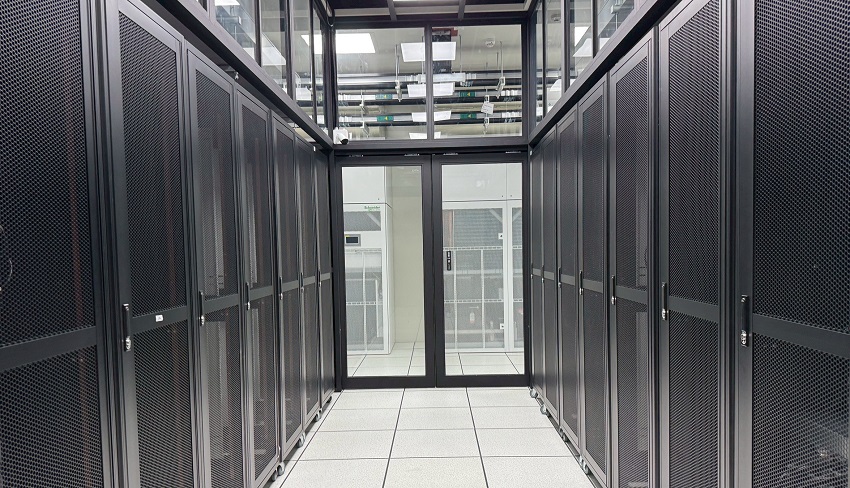
Leveraging Three Highs and Three Speeds Advantages to Facilitate Private Compute and Hybrid Cloud Strategies
The AI boom necessitates the modernization of IT infrastructure, requiring data centers to evolve and provide the optimal operational environment for next-generation AI servers. This ensures faster and more effective returns on enterprise investment in AI computing power.
Chief Telecom’s LY2 AI Data Center is designed with advanced ‘Three-High’ specifications—High Power, High Load-Bearing Capacity, and High Heat Dissipation—to precisely meet the demanding requirements of AI computing. Chief is now offering an “International-Grade AI Infrastructure Ready-to-Use Liquid-Cooled Solution.” This service allows businesses to simply bring their AI servers for instant deployment, eliminating the time and resources needed to rebuild their own insufficient data center infrastructure.
According to Julius Tsai, Senior Director at Chief Telecom, enterprise AI development has entered the deep waters of long-term strategic investment, with demand for self-built AI computing power accelerating exponentially. With over 20 years in the IDC business, Chief Telecom has synchronously upgraded its data center infrastructure to become a solid partner in enterprise AI strategy. We satisfy all the essential needs—space, power, liquid cooling, and high-speed networking—in a single solution, allowing enterprises to execute their AI strategies without any infrastructure concerns.
A Three-High Data Center Custom-Built for AI Compute
According to IDC, servers with embedded GPUs, are projected to grow 46.7% year-over-year, representing almost 50% of the total market value. It’s highlighting AI computing power as a fiercely competitive domain.
In the race for speed, enterprises commonly select hardware while simultaneously scrambling to secure data center space, bringing the challenges of traditional facilities to the forefront. A small AI server, for instance, requires approximately 10 kW; thus, a four-server rack needs 40 kW. Higher power density inherently demands greater heat dissipation. Given that the air-cooling limit for traditional data centers is generally below 20 kW (or is even lower), AI servers face significant risks of overheating, which can reduce performance, shorten their lifespan, or even cause system failure and complete downtime.
“A qualified AI data center must synchronize high-density power with advanced cooling, requiring a dual solution of air and liquid cooling. Liquid cooling requires professional planning and construction; even our newly built LY2 AI Data Center took considerable time to establish its highly available liquid cooling facilities. It would be extremely difficult for enterprise data centers to rapidly undertake construction or retrofitting of this caliber. In today’s highly competitive environment, where speed is critical to seizing opportunities, the LY2 AI Data Center is the ideal solution for enterprises.” said Julius Tsai.
Beyond its design for high power and heat dissipation, the LY2 AI Data Center offers the advantage of high load-bearing capacity. The LY2 building features a seismic isolation layer to withstand earthquakes of magnitude 7 or greater. With a floor load capacity of 2000 kg/m2, it is more than capable of handling the substantial weight of specialized GPU racks, which can weigh up to 1500 kg/m2.
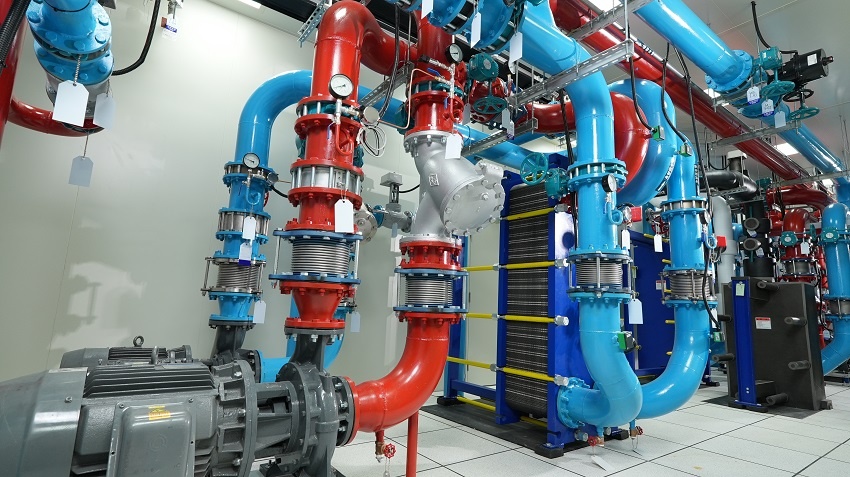 Liquid Cooling Facility
Leveraging Three-Speed Advantages for Rapid AI Deployment
In addition to the advanced Three-High design (High Power, High Load-Bearing Capacity, and High Heat Dissipation), Chief Telecom, as a leading international, carrier-neutral IDC provider, leverages over 20 years of data center experience to offer the unique advantages of “Fast Deployment, Fast Connectivity, and Fast Service.”
Regarding connectivity, Chief Telecom operates the most comprehensive network ecosystem, integrating extensive domestic fiber backbones, international submarine cables, and internet bandwidth. Operating both the Taipei Internet Exchange (TPIX) and Chief Cloud Exchange Center (CCX). Chief can offer direct access to the five major public clouds. This robust infrastructure is ideal for the high-speed data collection, transmission, and hybrid cloud integration demanded by AI applications.
In terms of deployment, Chief Telecom’s professional team offers instant, high-efficiency technical support and data center management, which is crucial given that AI servers lack standardization and vary greatly by brand and specification. Julius Tsai further explained: “As a leading international neutral IDC operator, Chief Telecom holds international-level certifications for cybersecurity and data center management. Our power, water, and backup designs meet the most advanced international industry requirements. Enterprises simply bring their self-purchased AI servers, and they can be operational within two weeks, rapidly implementing their AI applications and enjoying international-grade service quality.”
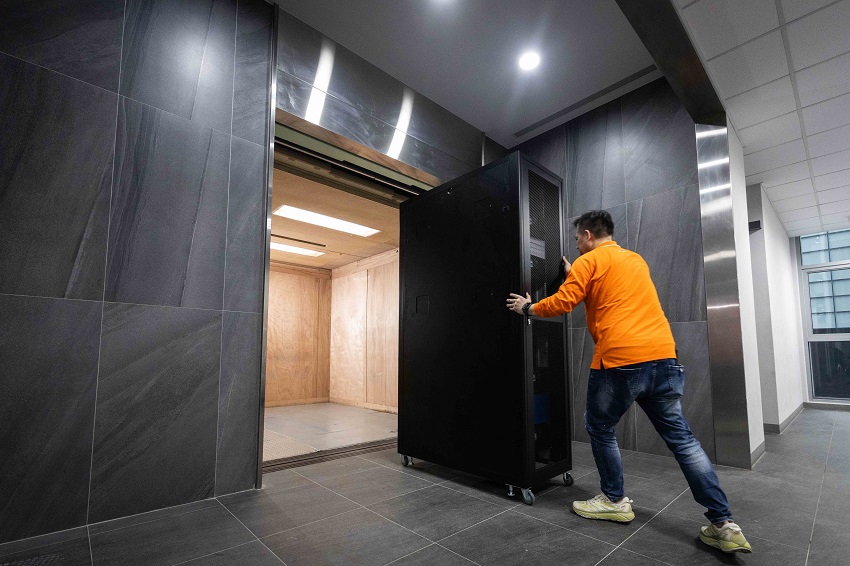 5T Cargo lift
The Dual Consideration of Cost-Effectiveness and Information Security
Current enterprise AI strategies are focused on achieving cost-effectiveness and high performance while safeguarding data sovereignty and leveraging a secure, flexible, and timely hybrid cloud approach. The trend toward private compute resources is accelerating. This shift is crucial because it eliminates the unpredictably high long-term costs of public cloud dependency and ensures the low latency and high performance necessary for time-critical AI applications like smart manufacturing and real-time financial analytics.
The core reasons for enterprises to adopt the LY2 Ready-to-Use liquid-cooled solution are cost-efficiency and data security. AI application development is a race against time: the faster results are achieved, the sooner market opportunities can be seized. Consequently, enterprises cannot afford to spend time and resources constructing or retrofitting old data centers. Furthermore, the industry consensus holds that keeping sensitive data and model training local, within owned or managed on-premise facilities, is the most secure practice.
According to Julius Tsai, the hybrid cloud model is a necessary strategy for enterprises seeking to balance the cost, performance, security, and flexibility required for AI. Chief Telecom positions itself as the key hub to enable this strategy by providing a ‘home’ tailored to high-spec AI servers. Crucially, we integrate our core network services to create a highly secure ‘bridge’ connecting public clouds, enterprise on-premise systems, and our compute facility, thereby maximizing the security and availability needed for enterprises’ high-value digital assets to operate seamlessly.
