




Chief Telecom’s TPIX Enters Global Top 50; Targets Asia’s Top 3 Within Three Years

As the digital economy and AI applications continue to flourish, the role of Internet Exchange Points (IXPs) is more critical than ever. Chief Telecom’s Taipei Internet Exchange (TPIX) has reached a new milestone in its global expansion. By strengthening its connectivity with major international network hubs across Europe, the U.S. West Coast, and beyond, TPIX has grown its membership to 285 service providers. This growth has successfully propelled TPIX be ranked as the 41st largest internet exchange operator globally.
TPIX has established international nodes in Japan, Hong Kong, and Singapore, and recently expanded its footprint to the U.S. West Coast and Europe. This expansion aims to build a more comprehensive and robust global peering ecosystem.
Following its milestone entry into the global top 50 IXPs in 2026, TPIX aims to leverage its enhanced connectivity to further grow its membership over the next three years, with the goal of becoming one of the top three Internet Exchange Point in Asia.
The primary function of an Internet Exchange Point (IXP) is to provide a physical location where Internet Service Providers (ISPs), Content Delivery Networks (CDNs), enterprises, and Cloud Service Providers can interconnect directly and exchange traffic. This process, known as peering, enhances network performance and reduces operational costs. By eliminating the need for data to transit through third-party networks, an IXP significantly reduces latency and minimizes routing expenses.
Without an IXP, network traffic must typically transit through international or third-party carriers, leading to increased latency and higher bandwidth costs. In contrast, an IXP enables network providers to engage in direct peering, exchanging traffic locally. This not only boosts transmission speeds but also significantly reduces the latency caused by redundant routing.
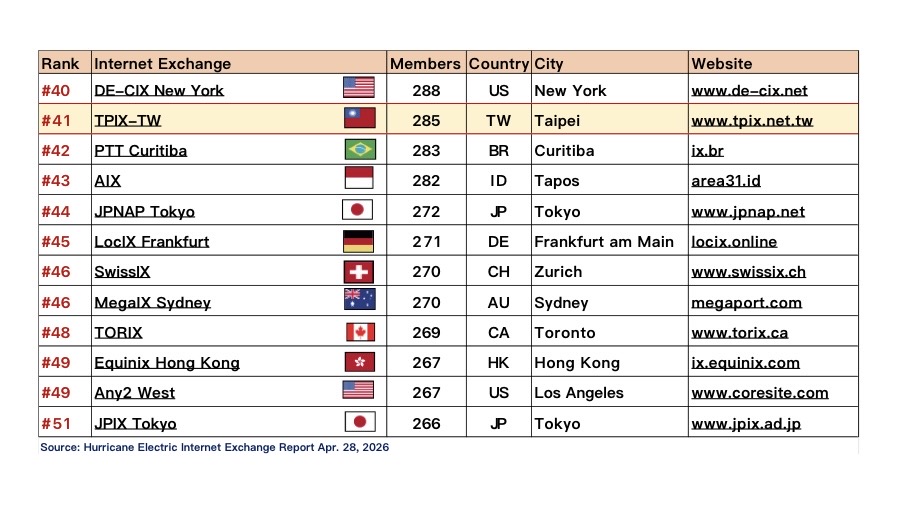
Image Source: https://bgp.he.net/report/exchanges
